




Description
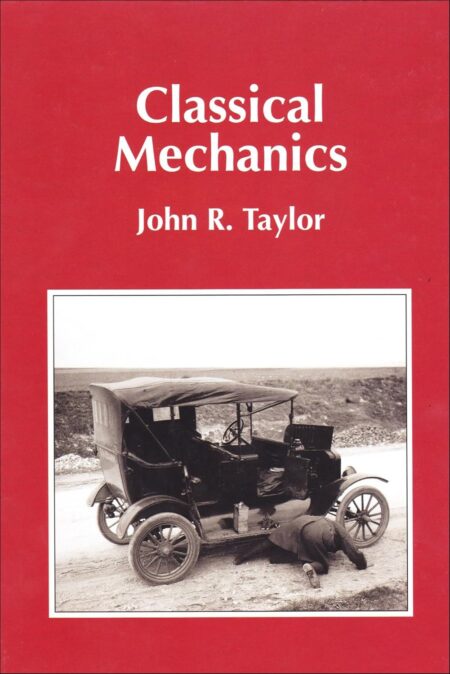
Classical Mechanics
Classical Mechanics by Taylor is an introduction to advanced undergraduate mechanics for students who have completed an introductory physics sequence. Written by John R. Taylor, the book bridges basic Newtonian mechanics and the more formal analytical approaches used in higher level physics and engineering courses. Taylor emphasizes physical intuition while building the mathematical framework needed to analyze real mechanical systems.
Core topics such as conservation laws, oscillatory motion and two body dynamics come early, followed by systematic treatments of Lagrangian and Hamiltonian mechanics, rigid body motion, non-inertial reference frames and normal modes. The text also extends into chaos theory and continuum mechanics, so students see both classical foundations and more modern applications.
How the book builds understanding
The book favors clarity of explanation and physical understanding over abstract formalism, walking students through each idea before formalizing it mathematically.
Problem sets in every chapter
Each chapter ends with a graded problem set, over 700 problems in total, ranging from conceptual exercises to advanced analytical and computational challenges. Problems are organized by topic and difficulty, so the book supports both self study and formal coursework.
Who this textbook suits
Classical Mechanics is used widely in physics programs and works as a primary textbook for physics majors, engineering students and mathematically inclined learners who want a rigorous treatment of the subject.
Book details
- Title: Classical Mechanics
- Author: John R. Taylor
- ISBN-13: 9781891389221
Questions buyers ask
Who is Classical Mechanics by Taylor written for?
Undergraduate physics and engineering students who have completed an introductory physics sequence and are ready for a more formal analytical approach.
Does it cover Lagrangian and Hamiltonian mechanics?
Yes, both are covered in full, along with rigid body motion, non-inertial reference frames and normal modes.
How many practice problems does it include?
Over 700 problems across the chapters, graded by topic and difficulty, from conceptual questions to advanced analytical and computational work.
Does it go beyond classical Newtonian topics?
Yes, the text extends into chaos theory and continuum mechanics alongside the classical foundations.
Is this book suited to self study?
Yes, the graded problem sets and the emphasis on physical understanding over abstract formalism make it workable for self study as well as coursework.





Reviews
There are no reviews yet.