


Description
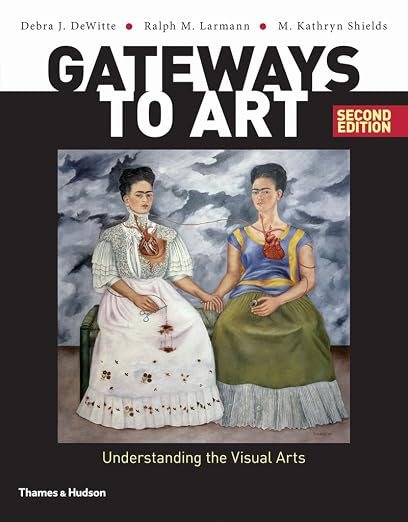
Gateways to Art: Understanding the Visual Arts, 2nd edition
Most art appreciation surveys march chronologically and hope something sticks. Gateways to Art takes a different route: a set of key works act as gateways, returned to repeatedly across the book from the perspective of media, history, theme and analysis. By the end, students have seen the same painting through four or five different lenses, which is what art historians actually do.
Written by Debra J. DeWitte, Ralph M. Larmann and M. Kathryn Shields, it is one of the most widely adopted art appreciation texts in North American colleges.
How the book is organised
- Fundamentals: line, shape, form, colour, composition and the vocabulary of visual analysis.
- Media and processes: drawing, painting, printmaking, sculpture, photography, film, architecture and digital media.
- History and context: a global survey rather than a purely Western one.
- Themes: art and its relationship to nature, the body, ritual, power and social change.
- Content and analysis: a dedicated chapter modelling detailed step by step readings of seminal artworks.
What is new in the second edition
- Greater emphasis on visual culture and contemporary art.
- All new Visual Galleries concluding each chapter, drawing connections across the text.
- Revised and expanded throughout, at 688 pages.
Who this book is for
- Students taking introductory art appreciation or art history survey courses.
- Studio art students needing critical vocabulary for critique.
- Museum and gallery visitors who want to read what they are looking at.
- Teachers looking for a thematically organised alternative to a straight chronology.
Book details
- Title: Gateways to Art: Understanding the Visual Arts
- Authors: Debra J. DeWitte, Ralph M. Larmann, M. Kathryn Shields
- Edition: 2nd
- Publisher: Thames and Hudson, distributed by W. W. Norton and Company
- ISBN-13: 9780500292037
- Format: Paperback, 688 pages
- Genre: Art Appreciation Textbook
Questions buyers ask
Who is Gateways to Art written for?
Students taking introductory art appreciation or art history survey courses, studio art students needing critical vocabulary, museum and gallery visitors, and teachers wanting a thematically organised alternative to a straight chronology.
Is this organised chronologically or by theme?
By theme. Instead of a straight chronological march, key works return repeatedly across the book from the perspective of media, history, theme and analysis.
What changed in the second edition?
Greater emphasis on visual culture and contemporary art, all new Visual Galleries concluding each chapter, and revisions and expansion throughout to 688 pages.
Does it cover art history beyond the Western tradition?
Yes. The history and context chapter is a global survey rather than a purely Western one.
Is this the paperback edition?
Yes. ISBN 9780500292037 is the Thames and Hudson paperback, distributed by W. W. Norton and Company, 688 pages.







Reviews
There are no reviews yet.