



Description
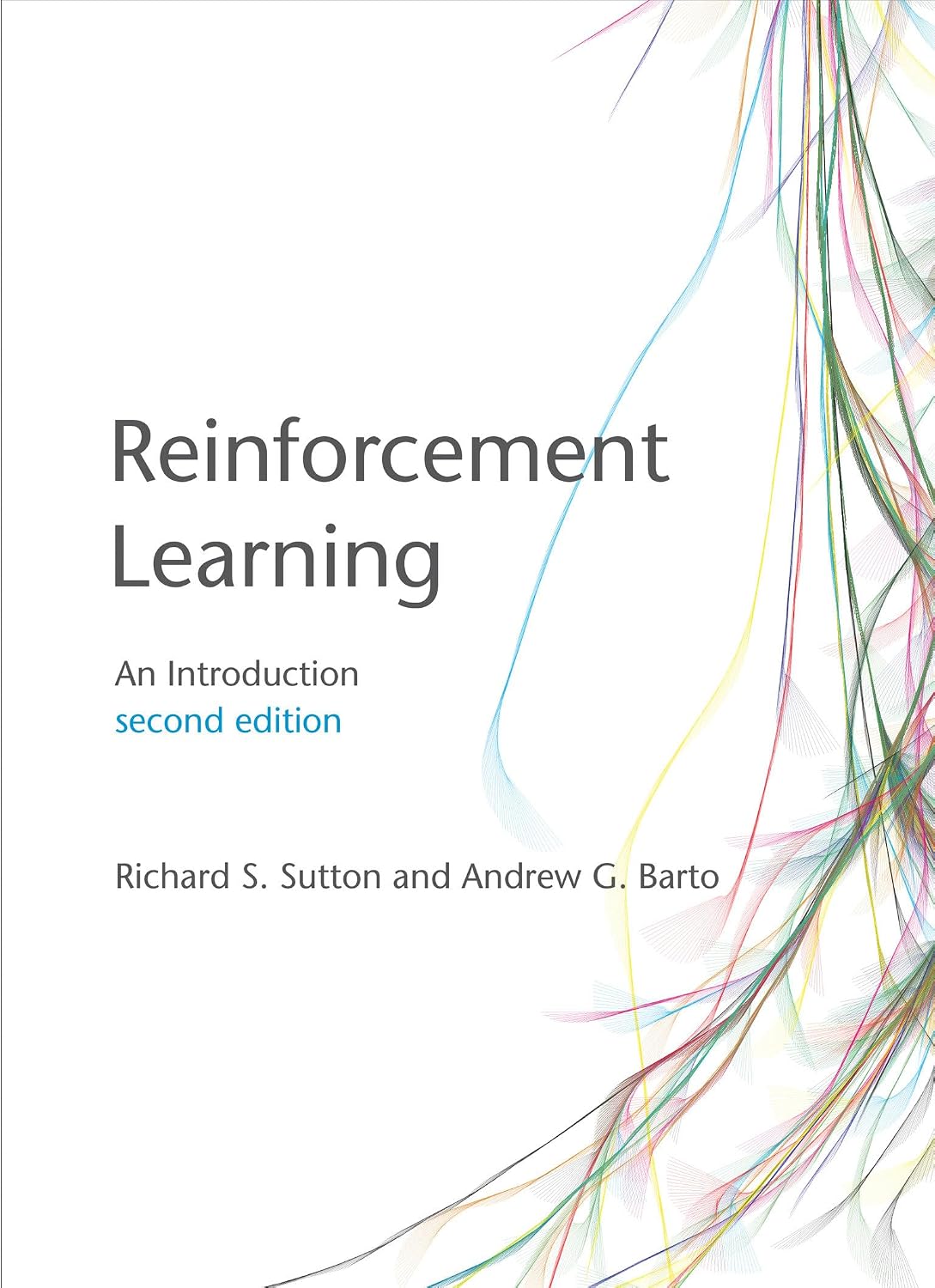
Reinforcement Learning: An Introduction, Second Edition
Ask anyone working in reinforcement learning where to start and this is the answer you get. Richard Sutton and Andrew Barto wrote the field’s standard text, and this reinforcement learning an introduction second edition, expanded and updated from the 1998 original, remains the reference that university courses, research groups and self-taught practitioners build on.
The book develops its core ideas, value, policy, exploration versus exploitation, temporal-difference learning, in plain language first, with the mathematics available for readers who want it rather than imposed on those who do not.
How the book is organised
- Part I, tabular solution methods: multi-armed bandits, Markov decision processes, dynamic programming, Monte Carlo methods, temporal-difference learning, n-step bootstrapping and planning, all admitting exact solutions.
- Part II, approximate solution methods: on-policy and off-policy prediction and control with function approximation, eligibility traces and policy gradient methods, extending the tabular ideas to problems too large to enumerate.
- Part III, looking deeper: connections to psychology and neuroscience, plus applications and case studies that show the methods at work.
New in the second edition
- Expanded coverage, with new topics added and existing ones brought up to date.
- Continued focus on core online learning algorithms rather than a survey of everything.
- Mathematical material set off in shaded boxes so the main narrative stays readable.
- Updated case studies and a fuller treatment of the links to psychology and neuroscience.
Who should read it
Students taking a first course in reinforcement learning or advanced machine learning, and machine learning engineers and researchers who want the foundations behind modern deep RL rather than just the recipes. Robotics, control and operations research practitioners working on sequential decision problems use it too, along with readers moving into RL from a general AI or data science background.
Book details
- Title: Reinforcement Learning: An Introduction
- Authors: Richard S. Sutton and Andrew G. Barto
- Edition: Second Edition
- Publisher: Bradford Books / The MIT Press
- ISBN-13: 9780262039246
- Format: Hardcover, 552 pages
- Genre: Artificial Intelligence & Machine Learning Textbook
Questions buyers ask
Do I need a strong maths background for this book?
No. The core ideas are developed in plain language first, with the mathematics set off in shaded boxes so it is available without being required to follow the main text.
How does the second edition differ from the original?
It expands coverage substantially, adds new topics, updates the case studies, and gives a fuller treatment of the links to psychology and neuroscience while keeping the focus on core online learning algorithms.
Is this reinforcement learning an introduction book for beginners or researchers?
Both. Part I uses tabular methods with exact solutions for a first course, and Parts II and III move into function approximation and applications for engineers and researchers who want the foundations behind deep RL.
What format does it ship in?
Hardcover, 552 pages, part of the Adaptive Computation and Machine Learning series from MIT Press.
Does it cover policy gradient methods?
Yes. Part II covers policy gradient methods alongside on-policy and off-policy prediction and control with function approximation.





Reviews
There are no reviews yet.