



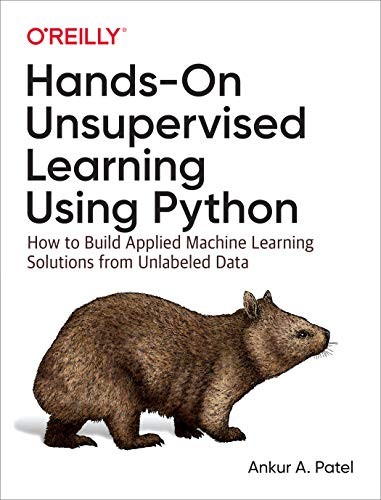
Description
Hands-On Unsupervised Learning Using Python: How to Build Applied Machine Learning Solutions from Unlabeled Data
Ankur A. Patel wrote this guide to unsupervised learning using Python for developers and data scientists who need to work with data that has no labels, which is most of the data that exists. It moves past supervised learning into clustering, dimensionality reduction, feature extraction and anomaly detection, using Scikit-learn and TensorFlow with Keras.
The book is hands-on: step-by-step code examples build a credit card fraud detection system, group users into clusters and generate synthetic datasets, connecting the theory to code a reader can run.
Core unsupervised techniques
Patel covers clustering, dimensionality reduction and feature extraction as the core toolkit, then extends into anomaly detection for cases like fraud, where there is no labeled example of what fraud looks like ahead of time.
Deep learning without labels
The book also covers autoencoders and generative models used in an unsupervised context, and walks through an end-to-end machine learning pipeline from data preparation and feature engineering through model evaluation.
Book details
- Title: Hands-On Unsupervised Learning Using Python: How to Build Applied Machine Learning Solutions from Unlabeled Data
- Author: Ankur A. Patel
- ISBN-13: 9781492035640
Questions buyers ask
Who is this book for?
Developers and data scientists who already know supervised learning and need to work with unlabeled data.
What tools does it use?
Scikit-learn and TensorFlow with Keras, the two Python frameworks used throughout the code examples.
Does it include real examples, not just theory?
Yes. Step-by-step examples build a credit card fraud detection system, cluster users into groups and generate synthetic datasets.
Does it cover deep learning?
Yes, autoencoders and generative models are covered within an unsupervised learning context.
What is the scope of the projects in the book?
End-to-end pipelines, from data preparation and feature engineering through model evaluation.





Reviews
There are no reviews yet.